Sales challenge: how Eli turns your incentives into measurable engagement
Written by Tony Demeulemeester, Co-founder & COO @ Eli
April 8, 2026 · Updated September 10, 2026 · 11 min read
Ready to engage your teams?
Create custom challenges that connect employees to your mission and drive real behavioral change.
High-performing sales teams are not built on bonuses alone. In 2026, the success of a sales contest depends on its ability to combine motivation, meaning, and measurable results. This article guides you step by step to organize a sales challenge that boosts your revenue while strengthening employee engagement.
Key takeaways
- A sales challenge is a structured competition that boosts sales, engagement, and team cohesion within your company.
- The Eli platform digitizes your incentive operations with gamification, artificial intelligence, and real-time measurement of participation rate, sales, and satisfaction.
- The most effective challenges in 2026 combine sales performance, employee well-being, and CSR impact to meet the expectations of new generations.
- Here you’ll find a concrete method and examples of sales challenges you can roll out this quarter to turn your objectives into results.
Definition and stakes of the sales challenge in 2026
What is a sales challenge? It is a lever for stimulating and steering sales that structures a temporary competition around specific objectives. Unlike a one-off incentive, a structured year-round challenge program keeps the sales force engaged on a regular basis and creates lasting momentum.
In 2026, the stakes are multiple. The market remains uncertain, teams work in hybrid mode, often spread across several sites and countries. Pressure on margins forces sales directors to optimize every action. Salespeople, for their part, expect more than a bonus: they seek recognition, development, work–life balance, and societal impact.
This is where a SaaS tool like Eli really comes into its own. The platform makes it possible to orchestrate, target, and measure these operations at scale, while adapting to the specific needs of each organization.

Strategic objectives of a modern sales challenge
Before launching a contest, you need to clarify your objectives. A modern sales challenge is not just about an immediate boost in revenue. Here are the four main objectives to prioritize:
- Immediate revenue boost: accelerate sales over a key period (product launch, end of quarter, seasonality)
- Development of new behaviors: active prospecting, consultative selling techniques, upsell and cross-sell
- Improvement of the customer experience: satisfaction rate, renewal, referrals
- Strengthening team cohesion and employer brand: sense of belonging, cross-team collaboration
More recent objectives are also emerging: participation in CSR campaigns, adoption of a new CRM, mastery of a new sales pitch. These challenges reflect the transformations of the business environment.
To translate these objectives into concrete indicators, Eli makes it possible to track participation rate, number of actions carried out, revenue generated, NPS, and completion rate of internal content. Alignment between the sales department, HR, and internal communications remains the key to avoiding “gimmicky” operations with no real impact.
Step-by-step organization of a sales contest
Organizing an effective sales contest requires rigorous planning. Here are the six steps to successfully launch yours.
Step 1 – Scoping
Choose your target: SDR team, KAMs, retail network, customer service. Define the geographical scope (France, Europe) and the duration: 2 weeks for a flash contest, 1 month for a standard format, one quarter for in-depth work.
Step 2 – Defining the rules
Set SMART success criteria. Establish quotas, progress bonuses, and tie-breaking rules. Plan clear arbitration in case of disputes. Everyone must understand the rules from the outset.
Step 3 – Configuration in Eli
The manager selects a template from the library (prospecting challenge, multi-KPI, CSR). They configure the objectives, points, badges, and schedule via drag & drop. Integration with the CRM enables automatic synchronization of results.
Step 4 – Launch and communication
Create a standard campaign with:
- An internal article explaining the purpose and key stakes
- A video from the Sales Director to embody the commitment
- Segmented emails and push notifications
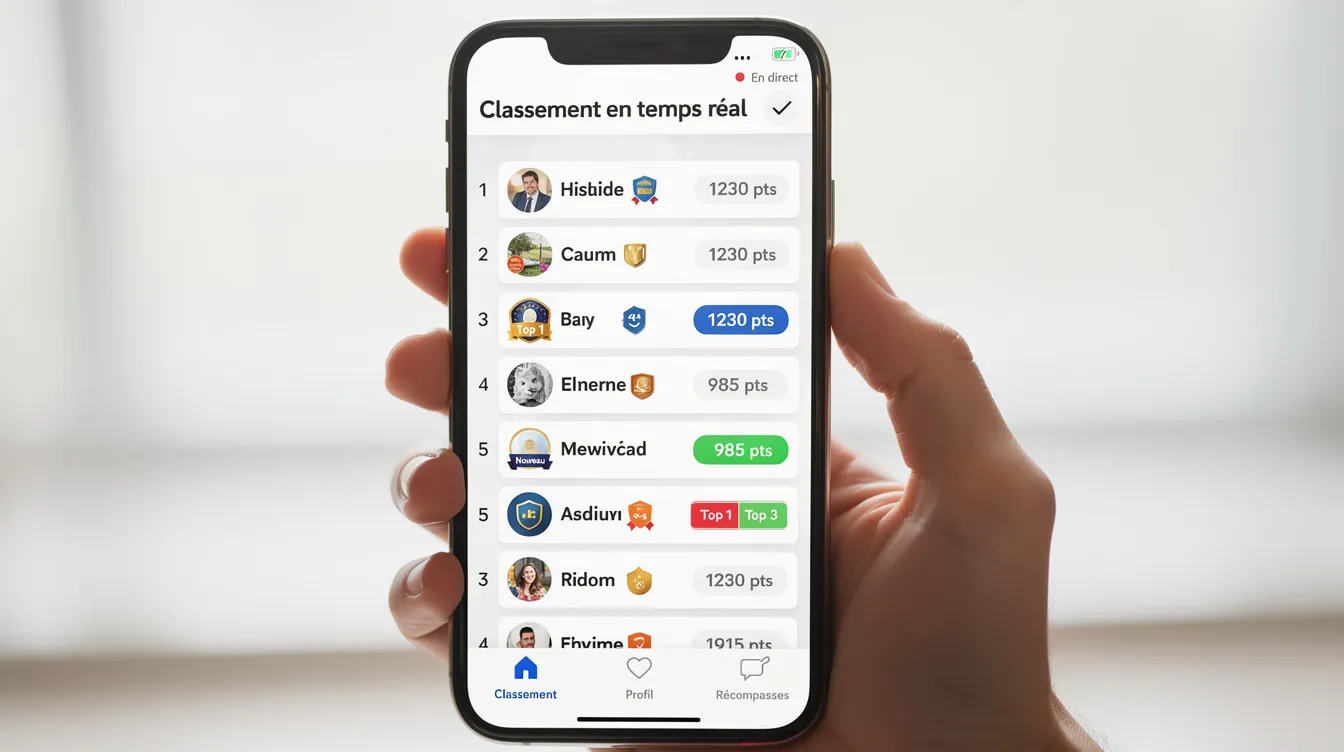
- Displaying the leaderboard in the Eli app
Step 5 – Ongoing engagement
Plan weekly checkpoints. Launch quick surveys to take the pulse of the teams. Add bonus mini-challenges and micro-learning content at each phase to keep the momentum going.
Step 6 – Wrap-up and review
Organize the distribution of prizes and rewards. Communicate the results: revenue generated, participation, CSR impact. Collect feedback via a quiz or a survey in Eli to improve future editions.
Types of sales challenges to manage with Eli
Several challenge formats can be adapted to your organization. Here are five to six examples of sales challenges to roll out, with specific durations, targets, and indicators.
“Smart Prospecting” Challenge
This one‑month format aims to increase the number of qualified B2B leads. Set a realistic numerical target: +30% SQL meetings between September and October 2026 compared with the previous quarter.
How it works: points are awarded based on lead quality (MQL, SQL, open opportunity).
Support content: call scripts, pitch videos, training quizzes that unlock bonus points once completed. Rewards can include sales coaching, certified training, or attendance at a high‑tech trade show in 2027.
“Revenue & Margin” Challenge
This quarterly challenge targets, for example, Q4 2026, with objectives not only for revenue but also for margin or product mix. The tiered mechanism works as follows:
- Tier 1: achievable by 80% of the team
- Tier 2: more selective
- Tier 3: reserved for top performers
The real‑time leaderboard in Eli shows progress by team. Badges mark milestones: first deal signed, monthly record. To access certain tiers, participants must have completed 80% of the training content on the 2026 sales pitch.
Bonuses can include gift vouchers, additional remote‑work days, or mentoring with a senior manager.
“Customer satisfaction & experience” challenge
This 2- to 3‑month format aims to improve NPS, CES, or renewal rate. Concrete actions include:
- Number of post-delivery follow-up calls
- Response rate to surveys sent via Eli
- Collection of reviews or video testimonials
Eli distributes micro educational content on active listening and handling objections. Target results: +20% survey response rate, +15% more customers giving a score of 9 or 10 out of 10. This type of challenge is also aimed at customer service, CSM, and support teams.
“Responsible upsell & cross-sell” challenge
This monthly format increases average basket size by focusing on useful and responsible offers. Points are awarded based on the relevance of recommendations: high value-added products, sustainable offers, support services.
Eli pushes tailored sales pitches and product sheets according to customer segments. An ESG/CSR angle can be integrated: bonus points when the upsell includes a service that reduces the carbon footprint. Consistent rewards include sustainable experiences, ESG/CSR training, or donations to a charity chosen by the winners.
“Multi-KPI & internal league” challenge
This “league-style” format lasts 6 to 8 weeks and combines several indicators: prospecting, conversion rate, satisfaction, participation in internal initiatives. Eli aggregates these KPIs into an overall score with weekly rounds and automatic re-ranking.
Running the challenge by sales teams (countries, branches, business units) encourages cooperation rather than individual competition. Gamified content includes weekly quizzes, flash missions, and collaborative challenges such as co-writing a sales script.
Typical objective: overall increase of 25 to 40% on a set of key indicators compared to the same period in 2025.
Digitalization, AI and gamification: what’s changing for your challenges
The era of challenges managed on paper or in Excel is over. SaaS platforms like Eli are radically transforming organization and innovation in this field.
Digitalization: real-time tracking, automated rankings, fewer errors, multi-device access (desktop, mobile, tablet). Your managers save hours of administrative work every week.
Artificial intelligence: generation of challenge ideas tailored to the company’s history, personalization of content and reminders based on participant profiles. AI anticipates the risk of disengagement.
Gamification: badges, levels, daily missions, storytelling (leagues, seasons, trophies). Cooperative mechanics complement competition to engage everyone, not just top performers.
Analytics: consolidated dashboards for HR, Internal Comms and Sales Management with filters by country, role, seniority, language. You can measure the impact of every initiative.
These components are built into Eli and do not require any in-house development. A manager can launch their first challenge in just a few hours.

Integrate CSR, well-being and internal communication into your challenges
In 2026, moving beyond a “pure numbers” logic is becoming essential. Employees expect meaning, balance, and societal impact in their day-to-day work.
Align commercial targets with CSR initiatives: for example, 1 solution sold = 1 tree planted, or extra points for selling offers with social impact. This approach boosts engagement while contributing to the company’s CSR objectives.
Well-being challenges linked to performance: number of steps, health workshops, time spent on QWL training. These initiatives can be monitored and driven via Eli, creating a link between personal well-being and collective success.
Enhanced internal communication: Eli makes it possible to share storytelling, leadership videos, opinion polls, and educational content around CSR. This engagement strengthens the employer brand, a key asset for recruiting and retaining talent in sales teams.
Measuring the impact of a sales challenge with Eli
A challenge without measurement remains just a game. With the right tools, it becomes a strategic lever. Here are the key indicators to track:
Here are the key indicators to track to measure the impact of a sales challenge:
- Incremental revenue, which corresponds to the income generated during the challenge compared with a normal period.
- The change in average basket size, i.e. the average amount per transaction.
- The conversion rate, meaning the ratio between the number of leads and the number of customers over the period.
- The Net Promoter Score (NPS), which measures the customer recommendation score.
- The participation rate, representing the percentage of employees actively involved in the challenge.
- The content completion rate, indicating the percentage of training courses and quizzes completed by participants.
- The number of CSR actions carried out, reflecting the teams’ responsible engagement.
These indicators provide a comprehensive view of sales performance, employee engagement, and the societal impact of the challenge.
Eli makes it possible to compare before/during/after, by period (e.g. Q2 2026 vs Q2 2025) and by segment (business unit, country, channel). HR and Internal Communications can identify which recognition mechanisms work best.
Concrete example: a company with 500 employees observes +20% participation in internal programs and +15% revenue on a targeted product range after 3 consecutive challenges. The allocated budget represents 3% of the incremental revenue generated.