Sports in the workplace: how to turn it into a measurable engagement lever
Written by Tony Demeulemeester, Co-founder & COO @ Eli
March 25, 2026 · Updated October 1, 2026 · 11 min read
Ready to engage your teams?
Create custom challenges that connect employees to your mission and drive real behavioral change.
Sports in the workplace have definitively moved beyond simple well-being to become a strategic tool serving human resources. In 2026, faced with increasing sedentary lifestyles and growing employee expectations, organizations that structure their sports activities are seeing concrete results in engagement, health, and cohesion. This guide helps you turn your initiatives into a sustainable, measurable program.
Key takeaways
- Sports at work have become a pillar of quality of life and working conditions (QVCT), integrated into HR, CSR, and employer brand strategies
- Employers have a clear legal framework (Labour Code, 2022 Sports Law) and significant tax exemptions on social contributions
- The benefits go beyond physical health: reduction of musculoskeletal disorders, improved mental health, and stronger team cohesion
- The Social and Economic Committee (CSE) plays a central role in funding and co-developing programs through the social and cultural activities budget
- Success depends as much on internal communication and gamification as on equipment
- A platform like Eli makes it possible to design sport & well-being campaigns, distribute them across multiple channels, and measure their impact by site, team, and language
Why workplace sports have become essential in 2026
The work environment has changed profoundly since 2020. The widespread adoption of remote and hybrid work has worsened sedentary lifestyles, while the Paris 2024 Olympic Games have created a nationwide momentum for sports participation, with a 19% increase in licenses in 2022.
Recent figures from Harmonie Mutuelle and QVCT barometers speak for themselves:
- Only 18 to 20% of companies offer sports activities
- More than 80% of employees say they want to exercise at their workplace
- MSDs (musculoskeletal disorders) account for 80% of recognized occupational diseases in France
The challenges for organizations now fall into three main areas:
- Health dimension: reducing musculoskeletal disorders (MSDs) and cardiovascular risks.
- Engagement dimension: improving eNPS (Employee Net Promoter Score) and better talent retention.
- Employer brand dimension: strengthening the company’s attractiveness and its CSR policy.
Workplace sports are now integrated into QWL and QVCT initiatives in companies in the same way as psychosocial risk prevention. Eli positions itself as a SaaS employee engagement solution to turn these initiatives into structured, measurable engagement programs.

Health at work: employer obligations and the role of the CSE
Article L4121-1 of the French Labour Code imposes a general safety obligation on the employer. This obligation includes the prevention of occupational risks, the information and training of employees, as well as adapting work organisation to reduce sedentary behaviour.
Promoting physical activity (active breaks, walking, yoga) directly contributes to this obligation by limiting MSDs and psychosocial risks. Since the 2024 Olympics, many organisations have integrated light mobility workshops into their daily routines.
The pivotal role of the CSE
The Social and Economic Committee is involved at several levels according to Article L2312-80 of the French Labour Code:
- Funding via the social and cultural activities budget
- Co-designing the programme with the HR teams
- Mandatory consultation for major adjustments
- Monitoring the implementation of actions
In companies with fewer than 11 employees or without a CSE in place, the employer directly assumes this responsibility but must pay particular attention to providing information and strictly guaranteeing that participation is voluntary.
Coordination between HR, the CSE, occupational health services and the safety officer remains essential to ensure that sports activities are compliant and genuinely useful for employees.
The concrete benefits of sport at work (physical, mental and collective)
The benefits of sports in the workplace fall into three complementary dimensions that contribute to the overall performance of the organization, and tie in with tools to improve quality of life at work.
Physical health
Office jobs expose 70% of employees to prolonged sedentary behavior. Regular physical activity helps to:
- Reduce MSDs (back, neck, shoulders)
- Improve cardiovascular fitness
- Strengthen posture through stretching and mobility exercises
Simple formats such as taking the stairs, bike commuting, or 10-minute active breaks produce measurable effects.
Mental health
Physical activity has a direct impact on stress and mental load:
- 25% reduction in stress through yoga sessions during the lunch break
- Improved sleep quality
- Increased concentration after 10–15 minute breathing breaks
Cohesion and team performance
Tournaments (soccer, volleyball, basketball) and connected corporate challenges (step counts, cycling challenges) break down hierarchical silos and strengthen bonds between teams. These actions are reflected in indicators monitored by HR:
- Reduction in absenteeism by 10–15%
- Increase of 15 points in eNPS
- Decrease in turnover
Through Eli, the company can track participation rates in sport and well-being campaigns in real time and cross-reference this data with QVCT indicators.
Legal and tax framework for workplace sport in France
The implementation of a sports program benefits from a favorable framework in 2026. Here are the key texts:
Law of 2 March 2022 (law aimed at democratizing sport in France)
- Explicitly encourages the practice of sport in the workplace
- Facilitates the opening of dedicated rooms and spaces
Article 18 of the 2021 Social Security Financing Act and decree of 28 May 2021
- Exemption from social security contributions on certain sport-related benefits
Exemptions as of 1 January 2026
Type of benefit and exemption ceiling:
- Internal collective sports facilities: exemption without ceiling provided they are accessible to all employees.
- External services, such as group classes or memberships: exemption capped at around €200.25 per employee per year.
- Overall exemption ceiling: limited to 5% of the Monthly Social Security Ceiling (PMSS) multiplied by the company’s headcount.
Conditions to be met:
- No discrimination in access
- Collective-type expenses
- Mandatory civil liability insurance
- Compliance of sports instructors (prefecture registration, qualifications)
- Hygiene and safety standards for equipment
To secure the setup, work with the payroll, legal and CSE teams. Eli makes it possible to document and track actions to facilitate internal reporting and justify exemptions.
What concrete forms can workplace sports take?
The approach must be adapted to the company culture, remote work and multi-site context. Here are the formats to consider:
On-site
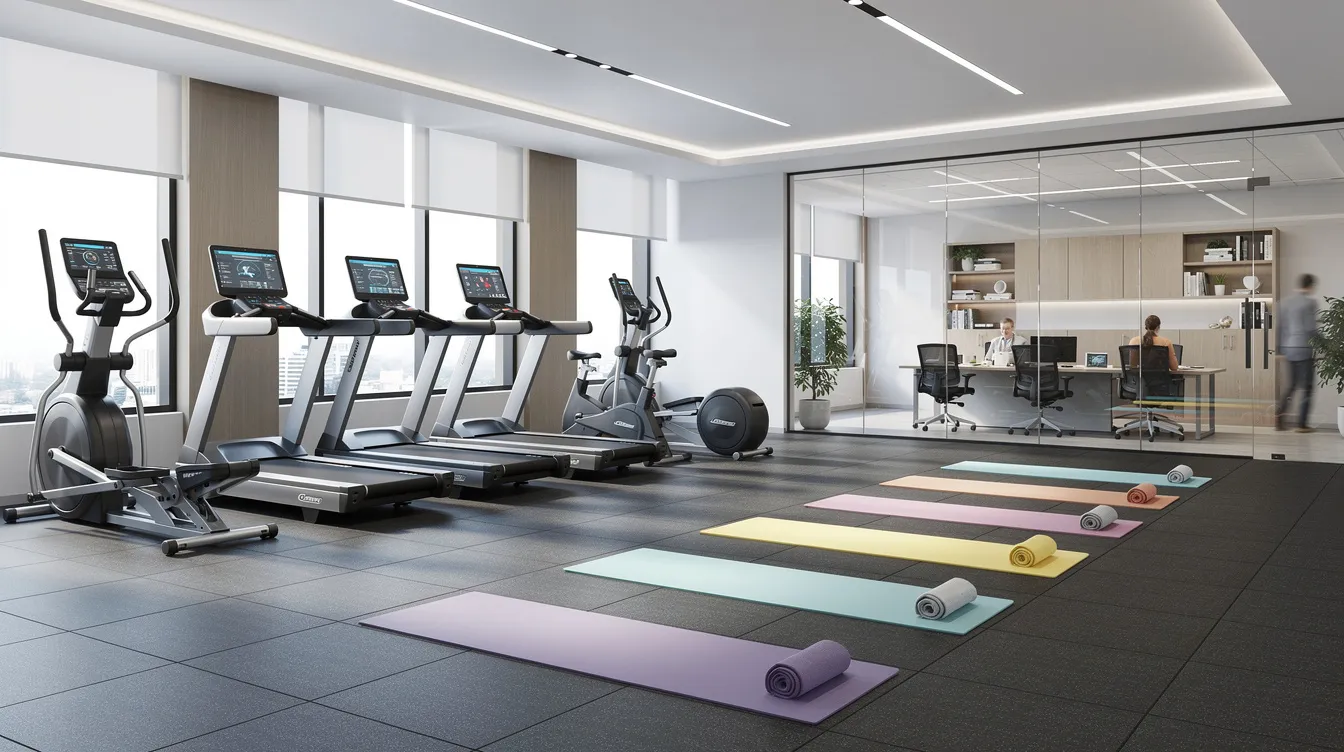
- In-house gym (even small, 20–25 m²)
- Yoga space in a meeting room
- Showers and changing rooms
- Fitness trail on the car park or rooftop terrace
Off-site
- Partnerships with nearby clubs or gyms
- Inter-company tournaments
- Charity runs (Paris 10K, Odysséa, Corporate Games)
- Participation in the National Corporate Sports Games via the FFSE
Connected and hybrid formats
- Step challenges with an app
- Live or replay workout videos
- Webinars on MSD prevention
- Collective preparation for a race
Gentle and inclusive formats
- Walking, Pilates, mobility exercises
- Breathing workshops to reach non-athletes
Eli centralises these different formats within themed campaigns (“October on the move”, “100,000 steps per team challenge”, “Global Workplace Wellbeing Week”).
Building a workplace sport strategy aligned with your HR objectives
Here is the six-step process to structure your project:
Step 1 – Diagnosis Analyse absenteeism data, QWL survey results, expectations raised within the Social and Economic Committee (CSE), and the geographical areas and teams most exposed to MSDs.
Step 2 – Co-construction Involve the CSE, managers, wellbeing ambassadors and occupational health services to define priority needs (e.g. reducing MSDs, limiting isolation among remote workers).
Step 3 – Objectives Define 3–4 time-bound indicators:
- 40% average participation by December 2026
- -10% short-term absences by the end of 2027
- +15 points on “the company supports my health”
Step 4 – Action plan List types of activities, frequencies, target audiences, pilot sites, partners, annual budget and timeline (seasonality, links with key moments, global health days).
Step 5 – Communication Plan a multichannel campaign (email, posters, intranet, app) with storytelling, visuals and an FAQ on safety and voluntariness.
Step 6 – Measurement Track opens, clicks and participation with Eli, run mini-surveys and adjust formats or schedules accordingly.
How to practically organize sports activities in your company
Checklist for your HR or Social and Economic Committee (CSE) team:
Setting up spaces
- Identify an available room or a flexible space
- Check ventilation, possible showers, and equipment storage
- Comply with fire safety and accessibility standards
Choice of time slots
- Test time slots before 9 a.m., lunch break, end of day
- Adapt according to production teams or customer service teams
- Plan flexibility for staggered working hours
Supervision
- Qualified external coach for high‑risk activities
- Trained internal ambassadors for light facilitation
- Usage charters for autonomous practice
Safety and liability
- Recommended self‑assessment of fitness to participate
- Display emergency numbers and first‑aid kit location
- Regular inspection of equipment and gear
Administrative logistics
- Agreements with service providers
- Up‑to‑date insurance certificates
- GDPR compliance if using apps or platforms
Eli automates registrations, reminders, replays, satisfaction surveys, and reporting by site and job role.
Engage employees and sustain the practice through internal communication
Many sports programmes fail due to a lack of clear and regular communication. Publishing information tailored to different audiences (head office vs field, multiple languages) is crucial.
Create a sports & well-being editorial territory
- Recurring sections in internal communications
- Testimonials from employees who practice sports
- Profiles of internal sports ambassadors
Vary the formats
- Short articles and 2–3 minute videos
- Educational quizzes on MSDs
- Quick polls on desired activities
- Team challenges with rankings by team
Leverage gamification
- Points and badges to reward consistency
- Rankings by site or team
- Symbolic rewards (charity donations, sustainable prizes)
Eli makes it possible to precisely target messages by country, site, language and job role, to plan campaigns over time, and to track interactions in real time.
Measuring the impact of workplace sports on engagement and performance
Moving from gut feeling to objective indicators remains essential to demonstrate the value of the programme to management.
Minimum indicators
- Participation rate in sessions and challenges
- Regularity of participation
- Reported satisfaction
- Sense of belonging
Advanced indicators
- Trends in short-term absenteeism
- Staff turnover
- Employee engagement survey results
- QWL (quality of work life) indicators related to stress
GDPR compliance
Data must remain aggregated and anonymous. No employee should be identifiable from their sports results. Clear information on how data is used is mandatory.
The Eli platform consolidates participation data, compares entities, and generates reports for executive committees and works councils, based on the best internal communication KPIs.
Showcase results regularly: share simplified summaries (number of participants, total time, amounts raised for a charity) to maintain the group effect.
How Eli can help you structure your sport & wellbeing programmes
Eli offers a complete solution to turn your sports initiatives into a measurable engagement programme:
Library of ready-to-use content Articles, videos, quizzes and actions to quickly launch campaigns without starting from scratch, with the option to create your own content.
Orchestrated campaign module Schedule over several weeks: invitations, reminders, games, surveys, collective challenges and reviews.
Multichannel distribution Email, push notifications and app, with adaptation by language and country for international groups.
Real-time measurement Dashboards with participation by activity, site and population. Identify engaged teams and those that need to be re-mobilized.
Take action: request a demo to see concretely how to structure your workplace sports campaign tailored to your organization.

FAQ – Workplace sport
Can workplace sport be mandatory for employees?
No, sports participation remains strictly voluntary. An employee cannot be sanctioned or penalized if they refuse to take part. Even during seminars or team-building days, the company must offer a non-sporting alternative. Forcing participation infringes on individual freedom and exposes the employer to legal risks.
Is a medical certificate required to take part in workplace sports activities?
No regulation makes a medical certificate mandatory for leisure activities organized in the workplace. In practice, the employer may recommend a health self-assessment questionnaire and advise consulting a doctor in case of doubt. Gentle activities (walking, stretching, light yoga) are generally accessible to everyone, but caution is needed for vulnerable groups.
How can we balance working hours and sports sessions without harming productivity?
Favour short formats (10–20 minutes) integrated into existing breaks or lunch slots. A pilot phase with a few teams allows you to adjust schedules and intensity before rolling it out more widely. Studies show that regular physical activity improves overall productivity through better concentration and reduced absenteeism.
What minimum budget should be planned to launch a workplace sports programme?
You can start with a few hundred euros for occasional workshops, active breaks via video and small equipment (mats, resistance bands). A small 20–25 m² room with equipment costs between €10,000 and €12,000 excluding VAT. Exemptions from social security contributions significantly reduce the net cost thanks to the provision of shared equipment.
How can remote sites and teleworkers be involved in the sports programme?
Connected challenges (number of steps, minutes of activity) work everywhere via a simple app or self-reporting form. Organise video classes (yoga, strength training) at times compatible with different time zones. Eli facilitates multilingual distribution, remote participation and team-based monitoring, including for employees who are rarely on site.