Top 7 Environmental Challenges in Business to Raise Employee Awareness
Written by Tony Demeulemeester, Co-founder & COO @ Eli
April 10, 2026 · Updated September 10, 2026 · 6 min read
Ready to engage your teams?
Create custom challenges that connect employees to your mission and drive real behavioral change.
Increasing regulatory pressure and stakeholder expectations are turning environmental initiatives into real strategic levers. A well-designed corporate environmental challenge doesn’t stop at raising awareness: it generates lasting behaviours, strengthens employee engagement, and boosts your brand image.
What criteria define a successful challenge? Quantifiable impacts, easy implementation, and a participation rate above 70% when communication is well managed. Here are the 7 best types of tested and approved challenges for 2026.
How we selected the best environmental challenges
Our selection is based on six proven criteria:
- Ease of implementation regardless of company size
- Measurable impact on eco-responsible behaviours
- Ability to create collective momentum through gamification
- Return on investment in CSR image and talent retention
- Adaptability to organisational and budgetary constraints
- Participation potential with precise tracking metrics
Top 7 Corporate Environmental Challenges for 2026
1. Soft Mobility Challenge
Description: Encourage your teams to favour cycling, public transport, or carpooling over a defined period of 2 to 4 weeks.
Why it works: Urban companies report a 15 to 25% reduction in emissions linked to commuting, measurable via a dedicated mobile app.
Ideal for: Companies in urban areas with available mobility infrastructure.
Strengths :
- Measurable CO2 savings (€0.05–0.10 per km)
- Health benefits: 15% reduction in sick days
- Concrete, visible actions in everyday life
Possible limitations : Difficult in rural areas, weather-dependent.
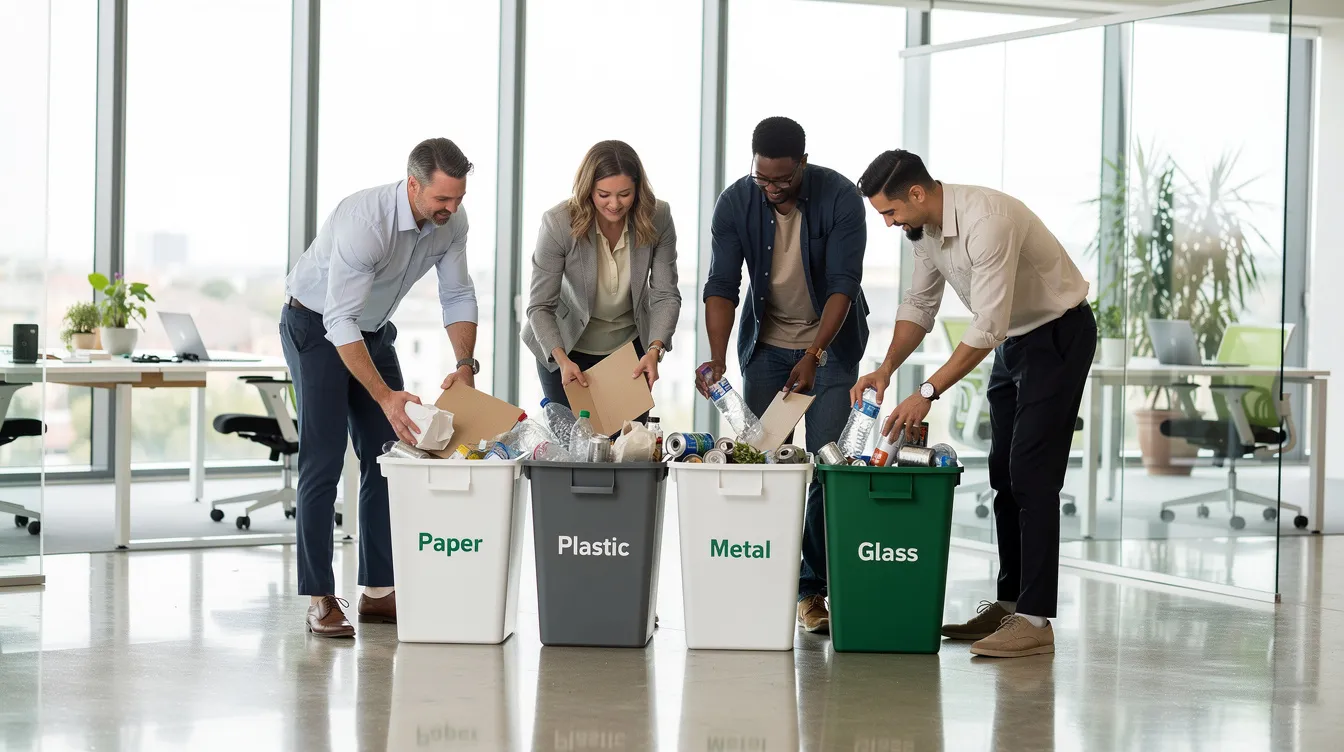
2. Zero Waste at the Office Challenge
Description : Minimize the waste produced in the workplace through sorting, composting, and reusable supplies.
Why it works : Results are immediately visible with bins that fill up less. French mid-sized companies report waste reductions of 30–50%.
Ideal for : All companies, particularly effective in office environments.
Strengths :
- Annual savings of €2,000 to €5,000 for 100 people
- Development of lasting habits through hands-on workshops
- Initial ROI within 6 to 12 months
Possible limitations : Upfront costs for bins (€500 to €2,000), coordination with service providers.
3. Personalized Carbon Footprint Challenge
Description: Each employee calculates their personal carbon footprint using tools such as ADEME and commits to measurable reduction actions.
Why it works: A personalized approach that generates a 10–20% annual reduction in individual emissions.
Ideal for: Tech companies or organizations with colleagues who are data-driven and focused on clear targets.
Strengths:
- Accurate data: 2 to 5 tonnes of CO2 reduced per employee
- Long-term tracking via dashboards
- Strong individual accountability
Possible limitations: May be perceived as intrusive; prioritize anonymized aggregate data.
4. Urban Eco Rally
Description: A walking or cycling route to discover local ecological initiatives: urban farms, zero-waste shops, environmental associations.
Why it works : Combines team building, local discovery and awareness-raising, with 80–90% participation observed.
Ideal for : Team seminars, companies wanting to strengthen team cohesion.
Key strengths :
- Fun and unifying like a game
- 25% increase in morale after the event
- Highlights the local ecosystem and region
Possible limitations : Complex logistical organization, requires permits.
5. Sustainable Food Challenge
Description : Promote vegetarian, local and seasonal meals through canteen partnerships or shared meals.
Why it works : Agriculture accounts for 14.5% of global emissions. Aiming for a 20–30% reduction in meat consumption generates a significant climate impact.
Ideal for : Companies with an in-house restaurant or a culture of shared lunches.
Key strengths :
- 1 to 2 kg CO2 saved per meal
- €10,000 to €20,000 in annual savings in collective catering
- Documented health benefits
Possible limitations: Cultural resistance in certain regions.
6. Collaborative Clean Walk
Description: Clean-up days in the company’s local environment, collecting 50 to 200 kg of waste per event.
Why it works: A concrete action with immediate visibility, strengthening team spirit and local image.
Ideal for: Companies wanting to get involved in their local area and work with associations such as Surfrider Foundation.
Strengths:
- Potential media coverage
- Minimal budget: €100 to €300 per session
- Effective team building outside the office
Possible limitations: One-off action requiring repetition.
7. Responsible Digital Challenge
Description: Reduce digital impact by cleaning up emails, limiting videoconferences, and recycling equipment.
Why it works: Emails and videos account for 4% of French emissions. Cleaning servers saves around 500g of CO2 per GB deleted.
Ideal for: Service-sector companies with intensive use of digital tools.
Strengths :
- 10–15% reduction in IT consumption
- Operational efficiency gains
- Eco-actions that can be applied both at home and at work
Possible limitations: Less visible results, requires prior awareness-raising on digital practices.
Quick comparison of the best environmental challenges
Here is a brief comparison of the different environmental challenges according to their optimal use and implementation complexity:
- Soft Mobility Challenge: Ideal for urban companies, this challenge has a medium level of complexity.
- Zero Waste Challenge: Perfect for starting a CSR approach with simple and quick implementation.
- Carbon Footprint Challenge: Suitable for data-driven companies, it requires more complex organisation.
- Ecological Rally: Designed to strengthen team cohesion, this challenge has a medium level of complexity.
- Sustainable Food Challenge: Suitable for companies with an in-house restaurant, with a medium level of complexity.
- Collaborative Clean Walk: Encourages local engagement with easy implementation.
- Responsible Digital Challenge: Recommended for the service sector, this challenge is easy to set up.
How to choose the right Environmental Challenge for your company
Choosing Based on Company Size
SMEs (fewer than 250 employees) tend to prefer low-logistics initiatives such as Zero Waste or Responsible Digital, which are quick to implement and require a CSR budget of less than €1,000. Large companies roll out Mobility or Rally challenges with dedicated CSR teams.
Choosing Based on Industry Sector
- Tertiary: Responsible Digital and sustainable development initiatives within the company
- Industry: Clean Walks and energy management
- Services: Footprint Challenge to enhance your brand image with clients
Choosing Based on CSR Maturity
Start with the Zero Waste Challenge to establish behavioural fundamentals, then move on to the Carbon Footprint Challenge for advanced monitoring that incorporates your sustainable development practices.
Which challenge is right for you?
- Choose Soft Mobility if you want a measurable CO2 impact
- Opt for Zero Waste if you are just starting your environmental journey
- Launch Carbon Footprint if your teams like precise data
- Organise an Eco Rally to combine competition and team building
Tips for making your Environmental Challenge a success
Upfront communication: Sharing information via the intranet and all-hands meetings achieves 85% initial buy-in. Ask the right questions and explain what is at stake.
Digital tools: An app like Eli makes it possible to centralize tracking, real-time gamification (quizzes, badges, points) and targeted communication. Companies double their engagement with these solutions.
Tiered rewards: Badges, days off, and €50 vouchers keep people motivated to take action throughout the environmental challenge.
Impact measurement: Before/after surveys and CO2 calculators generate average reductions of 10–30%. Share these results with all participants.
ESG integration: Turn your challenges into cultural norms through annual reports. Environmental responsibility then becomes an everyday reflex, not an exception.
The way you engage your employees on environmental topics defines your employer brand. With the CSRD requiring detailed disclosures for 2026, these initiatives are shifting from optional to a must-have pillar of your strategy. Identify the challenge that fits your context and take action today.